JCC Fellow Dr. Kate Cavanaugh’s latest research on the physics of fertility
Jane Coffin Childs Fellow Kate Cavanaugh Ph.D.’s research on the importance of mechanical properties for implanting embryos was recently featured on the cover of the September 2026 issue of Nature Cell Biology. Dr. Cavanaugh’s research drew wide interest and was also highlighted by two different “News & Views” articles in Nature Cell Biology and Nature Physics.
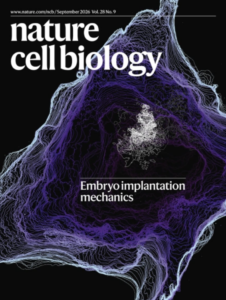
Embryo contact points color-coded by time during implantation. Image from Kate Cavanaugh and cover design by Lauren Snape.
Cavanaugh’s research focused on the central question of why female fertility sharply declines around the age of 35 years in humans. It was known that the majority of miscarriages occur at the stage of embryo implantation, a process that we’ll cover in more detail below. Additionally, it was known that chromosomal abnormalities in the embryo and fibrotic stiffening of the uterus contribute to this decline in fertility. Yet, Cavanaugh reasoned that there must be additional factors since live births using in vitro fertilization (IVF) are very successful in older recipients when using donor eggs from younger women.
Investigating the physics of early embryos
Thus, Cavanaugh set her focus on the embryo itself. To power her study, she confirmed that in mice, like humans, fertility rates plummet as the females age. In terms of comparing ages between mice and humans, the young and aged mice cohorts in Cavanaugh’s experiments correspond to humans in their 20s and 40s, respectively.
Next Cavanaugh wanted to investigate the physical properties of the early embryos. To understand why, we need to cover a little bit of background about the process of embryo implantation. During implantation the embryo docks on the uterine lining, then deforms on the proximal surface to facilitate attachment between the two, previously distinct, tissues.
Cavanaugh reasoned that this process is fundamentally similar to a drop of liquid hitting a surface like a table or a window pane. A droplet of water deforms nearly instantly, losing its round shape. A drop of honey, by comparison, will keep a round shape much longer because honey is more viscous than water. Compared to the everyday examples of water and honey the implanting embryo is more viscous and will keep much of its round shape throughout the implantation process. Yet, Cavanaugh demonstrated that being just malleable enough to integrate with the uterine lining is key for embryo implantation and successful live birth.
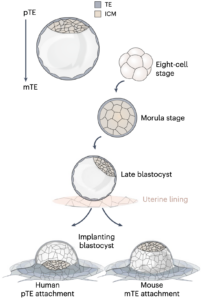
Schematic of embryos at the blastocyst stage implanting on the uterine lining from Cavanaugh et al, 2026.
Cavanaugh found that embryos from aged mice have different mechanical properties relative to those from young mice using a comprehensive array of techniques and analyses. She demonstrated that embryos from aged mice have higher surface tension, contractile energy, and viscosity by measuring these parameters directly. Other cues inferred the same results, such as embryos from older mice having reduced surface contact area when the embryo docks onto a surface mimicking the uterine lining, and changes in cell shape and relative orientation consistent with increased surface tension.
The parameter that Cavanaugh measured with perhaps the most translational application is the timing of embryo compaction. When the embryo is in the eight-cell stage it undergoes compaction into a more spherical shape. Cells that were previously protruding like a mini embryonic hernia get sucked in during this transition. On average, embryos from aged mice went through compaction more quickly than embryos from young mice, which makes conceptual sense given their increased surface tension. Yet, a few embryos from aged mice still had extended compaction transitions comparable to the average embryos from young mice. Cavanaugh thinks that these slower transitioning embryos would be better candidates in IVF, as we’ll discuss later.
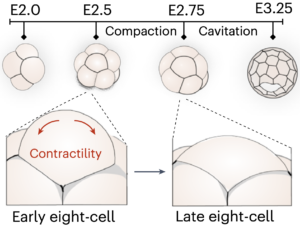
Compaction transition from early to late eight-cell stage in embryonic development. Figure from Cavanaugh et al, 2026.
Next, she tested whether the changes in mechanical properties were necessary and sufficient to change how embryos spread when docking to a surface. Basically, how does she know that this difference is due to mechanical forces rather than some other change between aged and young embryos? She used small molecules that modulate proteins that control cellular tension to tune the mechanical properties of embryos. Using one type of molecule (ripasudil) allowed embryos from aged mice to dock like those from young mice by loosening up their surface tension. Conversely, another type of molecule (CN03) made embryos from young mice act more like their aged counterparts by tightening up their contractility. These are the types of experiments that look great when sketched out on the back of a napkin, yet rarely do the results come out as clean and obvious as in Cavanaugh’s elegant examples.
Having developed a mouse model that recapitulated aging-related changes in fertility, Cavanaugh went on to use other model systems and observed similar differences in mechanical properties. Therefore, Cavanaugh suggests that identifying embryos with relaxed mechanical properties, similar to those from young egg donors, would help increase the success rates of IVF.
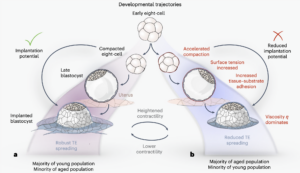
Differences in mechanical properties underlie uterine implantation potential in embryos from young and aged egg donors. Selecting for embryos with lower contractility or reducing the contractility of tense embryos are two possibilities for enhancing implantation outcomes. Figure from Cavanaugh et al, 2026.
Future Directions
Dr. Cavanaugh is currently on the job market applying for faculty positions. In her future lab she aims to continue her research at the intersection of embryo mechanics and reproductive aging, and build on these findings to improve IVF success rates.
One aim of her group is to validate compaction timing as an objective metric for selecting embryos with high fertilization potential. Cavanaugh notes that current metrics such as embryo shape are pretty subjective and thus vary substantially between clinics and clinicians. Many IVF clinics already have an embryoscope, which is an FDA approved microscope that tracks embryo development over time. For such clinics it would be relatively straightforward to analyze compaction times and use that as a more quantitative aspect of the embryo selection process.
Another aim is to investigate whether she can pharmacologically improve implantation and live birth rates for eggs from older mothers by administering the small molecule that relaxed the mechanical properties of these embryos.
Cavanaugh’s creative and unconventional approach to investigating the physical properties of embryos – as if they’re a liquid droplet – has clearly made a splash, sending waves into new lines of inquiry for improving the process of IVF. We look forward to seeing where her research spreads next!

JCC Fellow Kate Cavanaugh, Ph.D.