Fellow Focus: Jennifer Schmidt
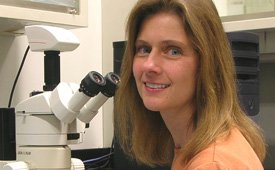
What appeals most to former JCCF Fellow Jennifer Schmidt about academic science are the many facets of the work, especially teaching and having the intellectual freedom to explore different questions. While continuing the genomic imprinting work she started during her 1996-2000 post-doc with Princetons Shirley Tilghman, its only one of four research areas going on in her lab today at The University of Illinois at Chicago. I have always had diverse interests, says Schmidt, after summarizing how she came to study the reproductive genetics of whale sharks, although Im a molecular geneticist at heart. Thats the common theme in all of our work.
Keeping every project moving forward, Schmidt says that the most promising project at present is a mouse model for congenital hydrocephalus. A poorly understood disease, hydrocephalus occurs in about 1 in 500 children and leads to increasing neuronal loss, disability, and death. Schmidt developed the model for hydrocephalus while trying to map the regulatory elements of the imprinted Dlk1 gene. The Dlk1 experiment actually failed, Schmidt recalls, as the best serendipitous experiments often do.
We created, unintentionally, a very good enhancer trap in the mouse, says Schmidt, and our transgene inserted directly into the center of an unstudied gene that appears to be involved in brain development and is important for fluid balance within the brain, disrupting the endogenous genes function. All the mice that have the transgene in that location go on to develop hydrocephalus as quite young animals. Its an ideal model for studying human hydrocephalus, says Schmidt, who is now talking with clinicians about the project: So we didnt start out to study hydrocephalus, but now we have the possibility to make a big impact on human health. Its a classic case of serendipity.